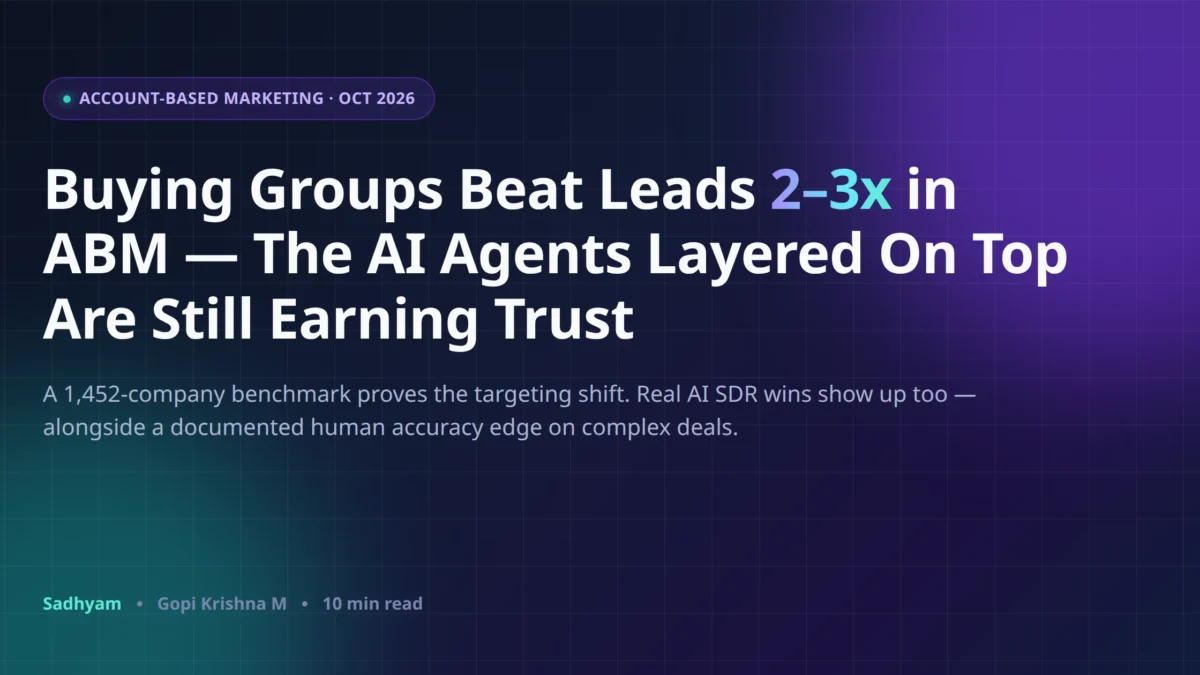
A massive new ABM benchmark proves buying-group targeting wins 2-3x more often than lead-based ABM. AI SDR agents are producing real, case-study-verified results in narrow tasks like meeting booking - but a 25-30% human accuracy advantage on complex qualification explains why leadership confidence hasn't caught up to the ROI numbers.
Key Takeaways
- Demandbase's 1,452-company State of ABM 2026 benchmark proves buying-group targeting (13-17 stakeholders, 2-3 groups per product) wins up to 2-3x more often than lead-centric ABM, independent of any AI tooling.
- Connecting CRM, marketing automation, and predictive scoring (3 systems) lifts MQA-to-pipeline conversion from a 14% baseline to 22%+; mature ABM programs post a 22.33% median conversion rate versus 14.19% for less mature ones.
- Qualified's AI SDR agent "Piper" has documented, case-study-verified wins: a 3.4x meeting-booking lift for Demandbase, 4.2x for Simpro, and $27M in pipeline influenced for Greenhouse in its first year live.
- Human SDRs still hold a 25-30% accuracy advantage over AI agents on complex, multi-stakeholder qualification, per Apollo.io - the core reason leadership confidence hasn't fully caught up to the ROI numbers.
- Documented AI SDR failure modes include hallucinated product claims, fabricated security certifications, and roughly 60% accuracy detecting sarcasm or objections in replies.
- Every source reviewed recommends a human-in-the-loop checkpoint before AI-drafted outreach reaches executive, pricing, or compliance-sensitive conversations.
If you’ve been told AI agents are “rewiring” account-based marketing in 2026, the honest picture is more interesting than that headline: part of ABM just got proven with hard data, independent of any AI story — and the AI agent layer on top of it is producing real, case-study-verified wins, but only in narrow tasks. There’s also a well-documented reason sales and marketing leadership confidence hasn’t caught up to the ROI numbers yet, and it’s not stubbornness.
A new benchmark study covering 1,452 companies says the real lever in ABM right now is one most teams aren’t pulling. A handful of AI agents are delivering measurable, repeatable results — but in specific, bounded jobs, not autonomous selling. And a separate body of research explains exactly why even strong ROI numbers haven’t fully won leadership over.

The ABM Data That Should Actually Change Your Budget
Demandbase’s State of ABM 2026 Benchmark Report is one of the largest datasets published on this: 1,452 companies, 429,634 ad campaigns, 38 million marketing activities, and 9.7 million sales interactions. The headline finding has nothing to do with AI — it’s about who you target.
Teams that build campaigns around buying groups (typically 13–17 stakeholders per account) instead of individual leads see up to 2–3x higher win rates. The report found a sweet spot of 2–3 buying groups per product for peak win rates, and buying groups that receive 180–190 touches reach a 94% conversion rate, while under-engaged groups convert far worse.
Integration matters just as much as targeting. Accounts where CRM, marketing automation, and predictive scoring are actually connected — three core systems — hit 22%+ MQA-to-pipeline conversion, against a 14% baseline for teams with limited integration. Mature ABM programs overall post a 22.33% median MQA conversion rate versus 14.19% for less mature ones, and companies tracking 3–4 buying groups see 48.5% higher win rates. Advertising compounds this further: running four ad products at the buying-group level produces a 58.7% win rate, a 71% lift over running no advertising at all.
A separate 2026 ABM benchmark survey from Demand Gen Report (published June 18, 2026) backs this shift in priorities: 56% of respondents now call new-account acquisition their primary ABM objective, 28% focus on account expansion, and nearly half are merging demand generation and ABM into one motion instead of running them as separate, competing budgets. As the report puts it, ABM has “graduated from a niche tactic into a core growth engine.”
None of this required an AI agent. It required measuring and targeting the right unit — the buying group, not the lead.
Where AI Agents Are Actually Winning (With Real Numbers)
The clearest documented ROI right now comes from Qualified’s AI SDR agent, “Piper,” which operates on Salesforce infrastructure and handles live chat, email follow-up, and meeting booking. The case studies are specific enough to check:
- Demandbase, running Piper on its own site, saw a 3.4x increase in meeting-booking rate year-over-year, $10M+ in pipeline influenced, and its qualified meeting rate climb from 2.6% to 8.8%. An abandoned-meeting follow-up flow alone lifted conversions by 15%. CMO Rachel Truair described it as reclaiming “pipeline that would have been lost otherwise.” (Qualified)
- Simpro saw a 4.2x increase in meetings booked and a 4x increase in meetings offered, with 20% of all inbound leads now sourced through the platform — validated with an A/B test against its own human BDR team, not just a vendor claim. (Qualified case study)
- Greenhouse attributes $27M in pipeline influenced to Piper in its first year live, across 15,000 conversations, 2,000 meetings booked, and $4M in closed-won revenue. (Qualified)
- Aiven reports a 260% increase in engagement, Piper booking 2x more meetings monthly than a human SDR, 34% more conversations monthly, and a 293% ROI figure. (Qualified)
That’s a consistent pattern: 2–4x lifts in speed-to-lead, meeting booking, and follow-up recovery — narrow, well-scoped jobs with a clear before/after metric.
Beyond meeting-booking agents, account-level orchestration is maturing too. 6sense runs account scoring on top of 13 years of proprietary intent data it calls “Signalverse.” Demandbase has its own “Agentbase” layer unifying sales and marketing on one account record. Newer entrants are carving out narrower niches: Metadata.io positions itself as a “full agent team” spanning audience building through reporting, Warmly bundles Bombora intent data with visitor identification, Common Room pulls signals from community and product-usage data that ad-network-based tools can’t see, and Influ2 runs person-level ads against named buying-committee members rather than whole accounts (rework.com). Worth flagging honestly: outside the Qualified case studies above, independently verified success-rate data for most of these account-level tools is thin — what’s published is largely vendor case studies, not third-party benchmarks, so a vendor’s ROI slide is a hypothesis to pilot, not a guarantee.
There’s also a second, quieter shift happening upstream: AI agents are increasingly doing the buyer’s own research, the same way they’re reshaping how people find information through search more broadly. That means agent visits to your site are becoming a real intent signal worth tracking, not just human page views.

Why Leadership Confidence Is Still Mixed (and Should Be)
The ROI numbers above are real, but they’re also exactly why it’s worth being precise about what AI agents are proven at versus what they aren’t. According to Apollo.io’s research on AI SDR limitations, human SDRs still hold a 25–30% advantage in complex qualification accuracy over AI SDRs, particularly in enterprise scenarios with multiple stakeholders — which is to say, exactly the buying-group scenarios the Demandbase benchmark says matter most (Apollo.io).
Tone and intent detection remain a real weak spot: research cited in Instantly.ai’s assessment of AI SDR tools found large language models around 60% accurate at detecting sarcasm, meaning a reply like “Oh great, another cold email” can get misread as a positive signal. The same assessment documents a more serious failure mode — AI agents inventing product capabilities, fabricating security certifications, and misquoting integrations in live conversations, without flagging the error, which is a genuine legal and trust exposure in any conversation that touches compliance or security (Instantly.ai). It’s the same trust gap showing up in how AI chatbots are already affecting buyer behavior on the consumer side — people (and apparently AI systems themselves) still struggle with nuance.
Adoption friction compounds the accuracy gap: 60% of sales leaders cite poor data quality as their top AI adoption challenge, and a 2025 survey cited by Apollo.io found 48% of sales enablement leaders still found adoption difficult even after deploying the tools. The recommendation that shows up across every source reviewed here is the same: human-in-the-loop, not full autonomy — AI drafts and qualifies, a human reviews before anything reaches an executive contact, a pricing conversation, or a compliance-sensitive claim.
So Is the Agent Layer Overhyped?
Not exactly — it’s real where it’s narrow. Two things are true at once: buying-group ABM is a proven, structural win worth adopting regardless of what you think about AI, and the AI agent layer on top of it is producing genuine ROI in specific, well-scoped tasks like meeting booking and follow-up recovery. Complex, multi-stakeholder qualification — the actual hard part of ABM — still has a measurable human-accuracy advantage. Leadership’s hesitation isn’t resistance to change; it’s a reasonable response to a documented gap.
What This Means for Your 2026 ABM Budget
If you want to act on this rather than just read about it, here’s the sequencing I’d use:
- Rebuild your measurement and targeting around buying groups (13–17 stakeholders, 2–3 per product) instead of individual leads — the single highest-leverage change the benchmark data supports, and it costs nothing in new tooling.
- Connect CRM, marketing automation, and predictive scoring. Three systems connected is the benchmark’s own threshold for the jump from a 14% to a 22%+ MQA-to-pipeline conversion rate.
- Deploy AI SDR or agent tools for narrowly-scoped, high-volume jobs — speed-to-lead, abandoned-meeting recovery, live chat triage — where the case studies above show consistent multiples, rather than for autonomous complex qualification.
- Keep a human-in-the-loop checkpoint before any AI-drafted message reaches an executive contact, a pricing discussion, or anything touching security or compliance claims.
- Make your product, pricing, and account-level content structured and legible to agents doing buyer research before a human ever reaches your site — the same groundwork covered in the Agentic Web Readiness Checklist.
- Treat any vendor’s published ROI numbers as a hypothesis to pilot, not a guarantee — run your own structured trial with an A/B comparison against your human team, the way Simpro did, before expanding a deployment company-wide.
My Take
The “AI is rewiring ABM” framing is a little misleading. What’s actually happening is a quiet split: the fundamentals of ABM — the buying-group math — just got independently measured and proven, with no AI story required, and that’s the higher-confidence move available to any team right now. The AI agent layer is a genuine productivity lift in a handful of well-scoped tasks, and leadership’s caution on the rest of it isn’t a failure to keep up — it’s a rational read of a documented accuracy gap that every source in this space keeps surfacing independently. The right sequencing for 2026 is to fix the targeting model first, then layer in agents task-by-task where the ROI is proven, with a human checkpoint on anything that touches trust.
What I’d Actually Check Before Budgeting for AI Agents in ABM
- Are we measuring and targeting buying groups (13–17 stakeholders) instead of individual leads?
- Are CRM, marketing automation, and predictive scoring actually connected end-to-end, or just integrated on paper?
- For any AI SDR or agent pilot, is there a human review gate before messages reach executive, pricing, or compliance-sensitive conversations?
- Have we run our own A/B test against a human benchmark before expanding an agent deployment company-wide, rather than trusting a vendor’s published case study alone?
- Is our product and pricing data structured well enough for an AI agent — ours or a prospect’s — to read it accurately without a human in the room?
Frequently Asked Questions
What is a "buying group" in account-based marketing, and why does it matter more than leads?
A buying group is the full set of stakeholders (typically 13-17 people, per Demandbase's 2026 benchmark) involved in a B2B purchase decision, rather than a single named lead. Targeting and measuring at the buying-group level produces up to 2-3x higher win rates than lead-centric ABM, because B2B deals are rarely decided by one person.
How much better do buying-group-based ABM programs actually perform, according to the data?
Demandbase's 1,452-company benchmark found buying-group-aligned teams see up to 2-3x higher win rates than lead-centric teams, mature ABM programs post a 22.33% median MQA-to-pipeline conversion rate versus 14.19% for less mature ones, and companies tracking 3-4 buying groups see 48.5% higher win rates.
Are AI agents actually producing real results in ABM, or is it still mostly hype?
Both are true in different places. AI SDR agents like Qualified's Piper have documented, case-study-verified wins in narrow tasks - a 3.4x meeting-booking lift for Demandbase, 4.2x for Simpro, and $27M in pipeline influenced for Greenhouse. But broader account-level orchestration tools have thinner independently-verified data, and complex multi-stakeholder qualification still favors human reps by a documented 25-30% accuracy margin.
What are the biggest risks of using AI SDR agents in ABM right now?
Documented failure modes include hallucinated product capabilities, fabricated security certifications, and misquoted integrations delivered confidently without flagging the error. Tone and sarcasm detection also lags, with research showing roughly 60% accuracy on sarcastic replies, which can cause objections to be misread as positive signals.
Should I deploy an AI SDR agent in my ABM program in 2026?
For narrow, high-volume, well-scoped tasks like speed-to-lead response, live chat triage, and abandoned-meeting recovery, the case-study data supports it. For complex, multi-stakeholder qualification, keep a human in the loop - every source reviewed here recommends human review before AI-drafted outreach reaches an executive, pricing, or compliance-sensitive conversation.
What's the single highest-leverage ABM change I can make this quarter?
Rebuild your targeting and measurement around buying groups (13-17 stakeholders, 2-3 per product) instead of individual leads. It's the change with the largest proven impact in the 2026 benchmark data, and it doesn't require any new AI tooling to implement.

Written by mootkur9
17 years in digital marketing. Founder of Sadhyam. Writing about AI search, AEO/GEO, and the agentic web. More about me →
References
- State of ABM 2026 Benchmark Report – Demandbase
- What the 2026 ABM Benchmark Survey Reveals About B2B Growth Strategy – Demand Gen Report
- With Piper the AI SDR, Demandbase Increased Pipeline by 2X – Qualified
- Simpro Achieves 4.2X More Meetings Booked with Qualified – Case Studies
- How Piper the AI SDR Agent Influenced $27M in Pipeline for Greenhouse – Qualified
- Aiven Doubles Their Meetings Booked with Piper the AI SDR – Qualified
- What Are the Limitations of Current AI SDR Tools in 2026? – Apollo.io
- AI SDR Limitations: An Honest Assessment – Instantly.ai
- Best AI Agents for Demand Generation in 2026 – rework.com