Five major companies have shipped competing protocols to let AI agents shop and pay on your behalf, all within the last twelve months. The infrastructure race is real and well-funded. The consumer adoption behind it isn't — yet. Here's the data on both sides, and what it actually means if you're not Amazon or Etsy.
Key Takeaways
- Google (AP2), OpenAI (ACP/Instant Checkout), Visa (Trusted Agent Protocol), and Mastercard (Agent Pay) have all launched AI agent payment/shopping protocols within roughly the last twelve months.
- Despite the infrastructure race, only about 3% of transactions today actually involve an AI agent, according to Checkout.com's June 2026 survey across six markets.
- 33% of consumers expect at least 10% of their purchases to be AI-driven within a year — but 24% say they'll never let AI handle a purchase, and 27% trust no organization to run a shopping agent for them.
- The agentic commerce market is valued at $7.7 billion in 2026 and forecast to grow at a 35.7% CAGR to $65.5 billion by 2033 (Grand View Research).
- Google's AP2 uses cryptographically-signed "Mandates" (Intent Mandate + Cart Mandate) to create a non-repudiable record of what a user actually authorized an agent to buy.
- For most B2B/SaaS businesses, the near-term priority isn't building a native AI checkout — it's making product, pricing, and entity data structured and agent-readable, since that's the same groundwork AI search visibility already requires.
In the last twelve months, Google, OpenAI, Visa, Mastercard, and PayPal have all shipped a protocol that lets an AI agent hold your payment details and complete a purchase without you clicking “buy.” That’s five of the largest companies in tech and finance, racing each other to build the rails for a future where your assistant does the shopping.
Here’s the number that doesn’t fit the hype: only 3% of transactions today actually involve an AI agent.

What Is Agentic Commerce, and Why Is Everyone Building for It Right Now?
Agentic commerce means an AI agent — not a human clicking through a checkout flow — completes some or all of a purchase on a person’s behalf: finding the product, comparing options, and paying for it within a set of rules the person approved in advance.
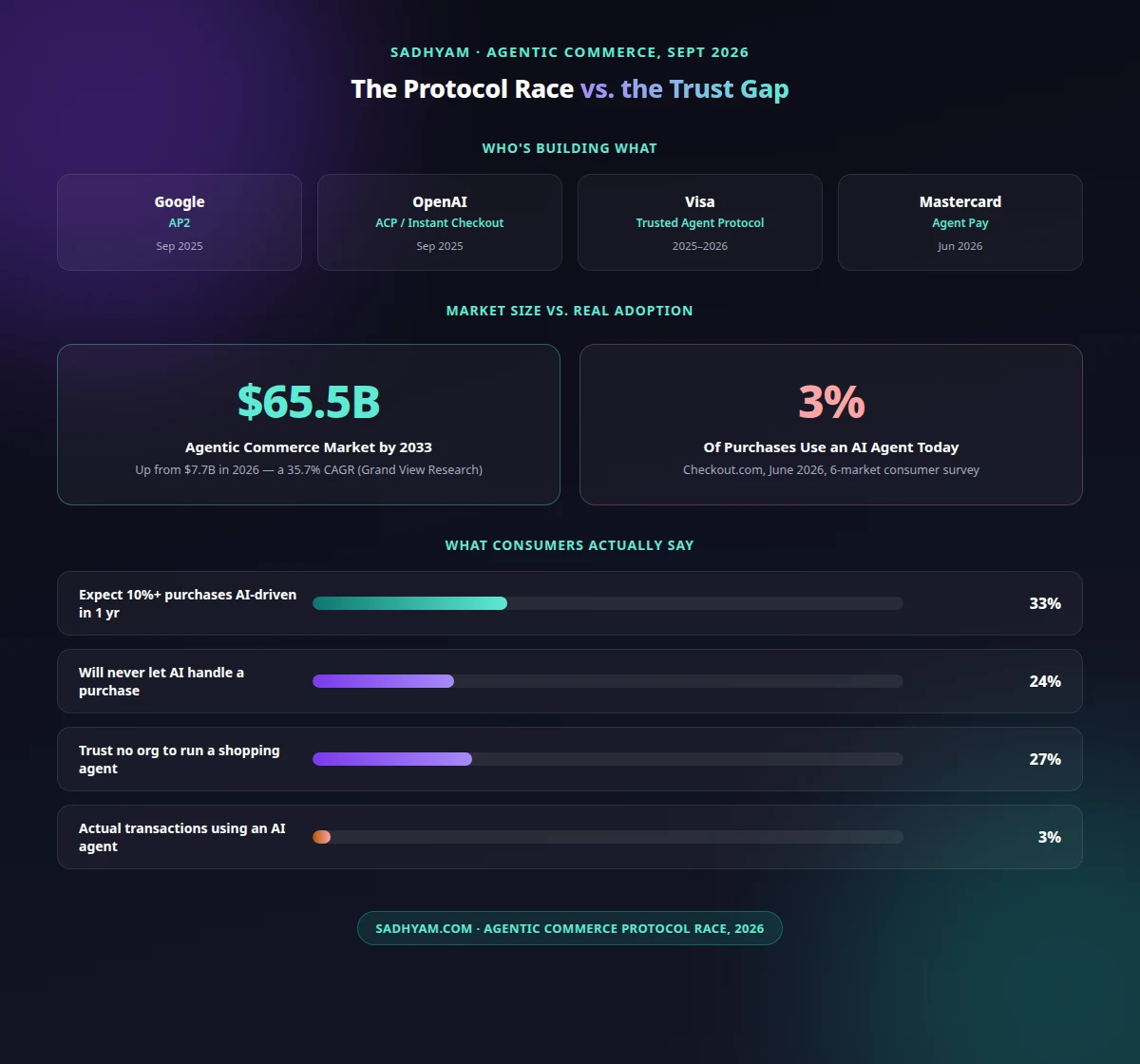
The reason five major companies shipped competing protocols inside the same twelve-month window isn’t coincidence. Google announced its Agent Payments Protocol (AP2) on September 16, 2025 (Google Cloud Blog). Thirteen days later, OpenAI launched Instant Checkout and the Agentic Commerce Protocol (ACP) inside ChatGPT, co-built with Stripe (OpenAI). Visa introduced its Trusted Agent Protocol the same year and has been pushing toward what it calls “mainstream adoption in 2026” (Visa). Mastercard followed in June 2026 with Agent Pay for Machines (Mastercard). Nobody wants to be the payment network or platform that AI agents can’t transact on when this actually takes off — the same pressure that’s pushing Google to start scoring sites on how agent-ready they are in the first place.
The Protocol Race: Who’s Building What
Each protocol solves a slightly different piece of the same problem — how does a merchant, a bank, or a card network know that an AI agent is actually authorized to spend a real person’s money?
| Company | Protocol | Launched | What It Actually Does |
|---|---|---|---|
| AP2 (Agent Payments Protocol) | Sep 16, 2025 | Cryptographically-signed “Mandates” prove a user authorized an agent’s purchase; 60+ launch partners including Amex, Mastercard, PayPal, Salesforce, Coinbase | |
| OpenAI | ACP / Instant Checkout | Sep 29, 2025 | Buy directly inside ChatGPT; co-built with Stripe; live on 1M+ Etsy sellers, Shopify merchants (Glossier, SKIMS, Spanx, Vuori) rolling out |
| Visa | Trusted Agent Protocol | 2025, mainstream push in 2026 | Lets a merchant verify an incoming AI agent is legitimate before a transaction is allowed to proceed |
| Mastercard | Agent Pay (for Machines) | Jun 2026 | “Always-on” machine-to-machine payments infrastructure for autonomous, recurring agent transactions |
| PayPal | Protocol-agnostic integration layer | Ongoing | Doesn’t pick a winner — offers merchants one integration that connects to AP2, ACP, and the card-network protocols at once |
The most technically interesting piece is how Google’s AP2 actually proves authorization. It uses cryptographically-signed “Mandates”: an Intent Mandate captures what you asked the agent to do (say, “find me white running shoes under $80”), and a Cart Mandate is generated and requires your approval once the agent has an exact cart — items, prices, and all — creating a non-repudiable record of what you actually agreed to buy (Google Cloud Blog). For purchases you pre-authorize without being present — a recurring reorder, a price-drop buy — the agent generates the Cart Mandate itself once your conditions are met.
PayPal’s own read on the landscape is worth noting because it’s coming from a company with no protocol to sell: it groups the field into commerce protocols (ACP, Google’s UCP), payment/trust protocols (AP2, Visa Trusted Agent Protocol, Mastercard Agent Pay), and infrastructure protocols (Google’s A2A, Anthropic’s MCP) — and argues merchants shouldn’t bet on one winner, because “support for multiple protocols will be needed to enable commerce experiences with the leading platforms” (PayPal Newsroom).
The Market Is Moving Fast — On Paper
The growth numbers explain the urgency. The global agentic commerce market was worth $5.7 billion in 2025, is estimated at $7.7 billion for 2026, and is forecast to grow at a 35.7% CAGR through 2033 — reaching $65.5 billion (Grand View Research). North America currently holds 38.2% of global revenue share, while Asia Pacific is growing fastest. Retail and e-commerce dominate the use cases so far.
But Consumers Aren’t Racing With Them
Here’s where the infrastructure race runs ahead of actual behavior. Checkout.com’s June 2026 survey across six markets, including the US and UK, found that a third of consumers (33%) expect at least 10% of their purchases to be AI-driven within a year — but almost a quarter (24%) say they will never let AI handle a purchase, and 27% say they trust no organization to operate an AI shopping agent on their behalf (Checkout.com). Put plainly: right now, only about 3% of transactions actually involve an AI agent.
The same survey found consumers aren’t rejecting the idea outright — they’re asking for guardrails before they’ll use it. The top three requirements were a spending cap (30%), the ability to instantly revoke an agent’s access (29%), and easy cancellation (28%). On average, people said they’d pre-authorize an agent to spend around £177 without needing to approve each purchase individually — useful context for how small the “unsupervised” transaction ceiling actually is today.
This tracks with what I found digging into how AI chatbots are already influencing purchase decisions earlier this month: consumers are far more comfortable letting AI talk them out of a purchase than letting it complete one automatically. Trust in an agent’s judgment and trust in an agent’s spending authority are two very different thresholds, and right now most people have only crossed the first one.
So Is This Hype, or Is It Real?
Both, depending on which half of the picture you’re looking at. The infrastructure is real, well-funded, and moving fast — five major companies don’t build competing payment protocols for a market that doesn’t matter. But the consumer side is still an early-adopter phase, not a mainstream shift. A 3% current-usage number next to a 35.7% CAGR forecast means most of that growth is still ahead of us, not behind us.
What This Actually Means If You’re Not Amazon or Etsy
Most B2B and SaaS marketers reading this aren’t going to build a native “buy with ChatGPT” button this quarter, and at 3% current adoption, that’s the right call — the volume isn’t there yet to justify the engineering effort for most businesses. But there’s a more immediate, lower-cost piece of this that’s worth doing now:
Agents are already reading your site to answer questions and make comparisons, even before they’re completing checkouts on it. That means your pricing pages, product specs, and structured data need to be legible to an agent today, independent of whether that agent can actually complete a purchase yet. The same entity signals and structured data that help you show up in AI Overviews and chatbot answers are the foundation any future checkout integration would sit on top of anyway — it’s the same groundwork I covered in the Agentic Web Readiness Checklist, and it overlaps heavily with getting your Search Profile Badge and Preferred Sources status right — the same verified-entity signals that help Google trust you are what a payment protocol’s credential system will eventually check too.
My Take
The protocol race tells you where the big platforms think commerce is headed, not how fast your customers are actually getting there. I’d treat 2026 as the year to get the groundwork right — clean structured data, accurate and agent-readable product and pricing information, clear entity signals — rather than the year to build a bespoke AI checkout flow for a use case that’s still 3% of transactions. The companies racing to build these protocols are playing a longer game than most of us need to play right now.
What I’d Actually Check on My Own Site
If you want to be ready without over-building, here’s where I’d start:
- Confirm your product and pricing data is in structured, machine-readable format (Schema.org Product/Offer markup), not buried in images or JavaScript-rendered text an agent can’t parse.
- Read up on WebMCP if you’re technical — it’s the emerging standard for letting agents take structured actions on your site, not just read it.
- Keep an eye on your referral mix as this shifts — my breakdown of how much traffic actually comes from AI sources today is worth revisiting once agent-driven purchases start showing up in your analytics.
- Don’t rush to integrate a specific checkout protocol yet — with five competing standards and no clear winner, PayPal’s “stay protocol-agnostic” advice is sound for most businesses.
Frequently Asked Questions
What is agentic commerce?
Agentic commerce is when an AI agent completes some or all of a purchase on a person's behalf — finding a product, comparing options, and paying for it — within rules the person approved in advance, rather than a human clicking through checkout themselves.
How many purchases actually use an AI shopping agent right now?
About 3% of transactions currently involve an AI agent, according to Checkout.com's June 2026 survey across six markets, even though a third of consumers expect at least 10% of their purchases to be AI-driven within a year.
What is Google's AP2 (Agent Payments Protocol)?
AP2 is Google's open protocol, launched September 16, 2025, that lets AI agents securely initiate payments using cryptographically-signed "Mandates" that prove a user authorized a specific purchase. It has more than 60 launch partners including American Express, Mastercard, PayPal, and Salesforce.
What is OpenAI's Instant Checkout?
Instant Checkout is a feature that lets ChatGPT users buy products directly inside a chat, using the Agentic Commerce Protocol (ACP) that OpenAI co-built with Stripe. It launched September 29, 2025 and is live with over one million Etsy sellers, with Shopify merchants rolling out.
Should my business build an AI checkout integration right now?
For most B2B and SaaS businesses, probably not yet — actual agent-driven purchases are still about 3% of transactions, and there are five competing protocols with no clear winner. A better near-term investment is making your product and pricing data structured and agent-readable, which pays off for AI search visibility regardless of which checkout protocol eventually wins.
How big is the agentic commerce market?
Grand View Research values the global agentic commerce market at $7.7 billion in 2026, forecasting 35.7% annual growth (CAGR) through 2033 to reach $65.5 billion, with North America holding the largest current share and Asia Pacific growing fastest.

Written by mootkur9
17 years in digital marketing. Founder of Sadhyam. Writing about AI search, AEO/GEO, and the agentic web. More about me →
References
- Announcing Agent Payments Protocol (AP2) – Google Cloud Blog
- Buy It in ChatGPT: Instant Checkout and the Agentic Commerce Protocol – OpenAI
- Visa Introduces Trusted Agent Protocol – Visa Investor Relations
- Mastercard Launches Agent Pay for Machines – Mastercard
- Making Sense of the AI Shopping Protocol Moment – PayPal Newsroom
- Agentic Commerce Market Size & Share Report, 2026-2033 – Grand View Research
- Agentic Commerce 2026: The State of Consumer Demand and Merchant Readiness – Checkout.com